
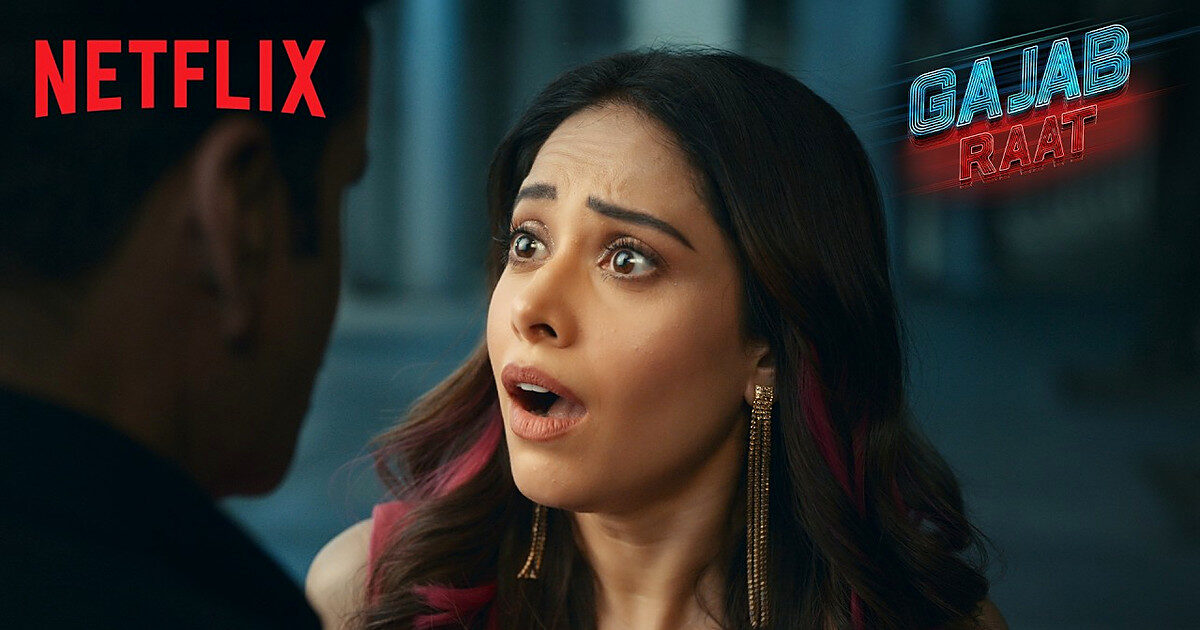
1. The setup: where the scene sits in the film and what is at stake
In Gajab Raat (2026), the hotel raid is already a pressure cooker. Manoj Bajpayee’s officer walks in not as a rescuer but as a man who hears everything, while Nushrratt Bharuccha’s character is caught mid-cover-story, with Kiku Sharda’s face announcing exactly how deep the trouble is. By this point, the film has spent enough time on her plan to make the raid feel like judgment, and enough time on Bajpayee’s officer to know his patience is thin.
2. The turn: the beat where the scene changes gear, and how the film gets there
The scene begins with Bharuccha controlling the room—talking, moving, arranging details. It changes gear when Bajpayee stops moving. Not a shout, not a slam; he simply lets her sentence hang. The film gets there by holding on him instead of cutting to the commotion, so her cover-up goes from confident to flimsy in real time.
3. The line: the line or the moment people quote, and why it lands
People quote Bajpayee’s flat “Accha?”—stretched just enough to be a verdict, not a question. It lands because the writing withholds the obvious outburst. His reaction is the punchline, and the timing lets her entire story collapse in the silence before it.
4. The performance: what the actor or actors do, precisely, that a lesser scene would not
Bajpayee does the smallest work: palms still, chin slightly down, eyes on her without blinking. Bharuccha, by contrast, adds too many details—her hands keep finding something to fix, which is exactly why she looks guilty. Kiku Sharda doesn’t rescue the scene; he watches it like the audience, his double-take doing the commentary a lesser film would put in dialogue.
5. The craft: the staging, the cut, the music, the sound, the camera, whichever carries it, with one specific choice named for each you mention
The staging frames the door as a trap: Bajpayee fills it, so Bharuccha has nowhere to exit. The cut stays on the two-shot long enough for discomfort, then breaks to Kiku’s reaction as the confirmation. The sound drops the room tone so the tiny noises—her phone landing, a drawer closing—become the only punctuation. The camera holds a slow push on Bajpayee’s face late, letting the deadpan grow.
6. Why it travels: why this scene is the one people share, decades or days later
The scene travels because it is ridiculously rewatchable: a great deadpan officer, a panicked cover-up, and a silent witness. It works without knowing the whole film, it fits in a clip, and Bajpayee’s reaction is the kind of moment fans share with one line of context.
Watch the original: Netflix India on YouTube. Shown for review and comment; the rights stay with the makers.