
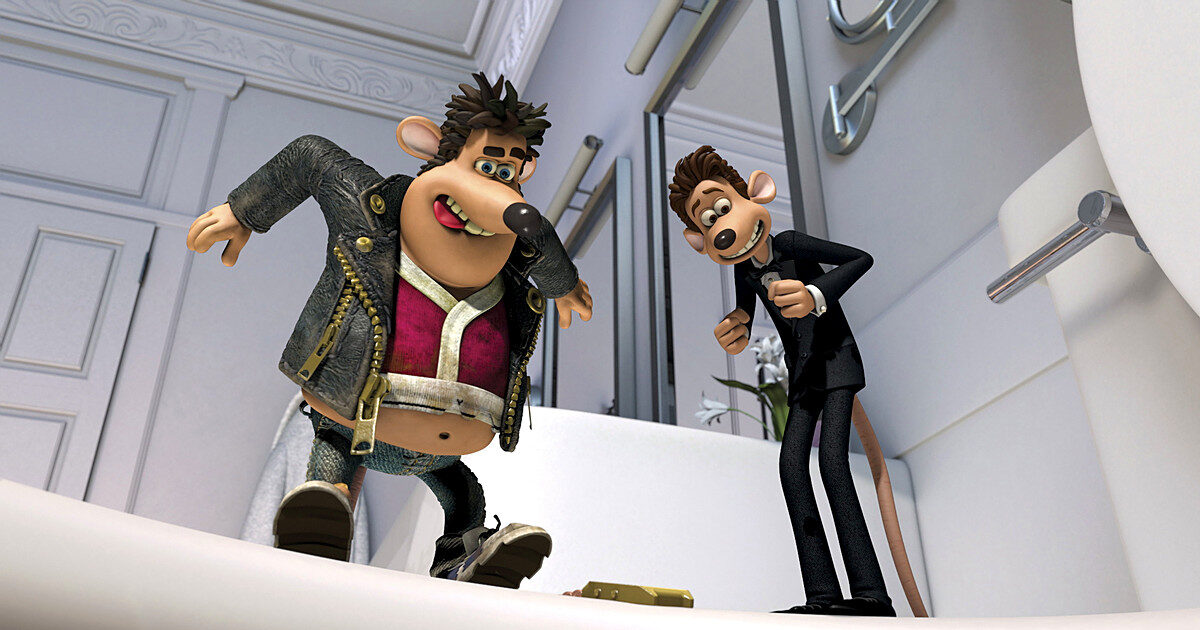
Flushed Away (2006) turns 20 this week, and its making-of story is still one of Aardman’s biggest pivots. The studio known for claymation made its first fully CGI feature because the story demanded water. Here is how a rat-and-sewer idea became a technical turning point.
An idea born during Chicken Run
During production of Aardman Animation’s Chicken Run (2000), animator Sam Fell proposed a film about rats that fall in love in sewers. Aardman was encouraging everyone at the company to come up with feature ideas for the DreamWorks Pictures and DreamWorks Animation partnership.
The pitch DreamWorks heard
In 2001, Fell, development executive Mike Cooper and producer Peter Lord developed the concept into a story before pitching it to DreamWorks. Lord described the pitch as “The African Queen with the gender roles reversed.”
Announced as a first
The film was first announced in July 2002. In what was then a surprise move, it was revealed as Aardman Animations’ first-ever all-3D CGI animation project. After the announcement, comic writing duo Dick Clement and Ian La Frenais were contracted to write the script with the working title Ratropolis.
A directing and writing team takes shape
David Bowers joined in 2003 to direct the film with Fell. Other writers were later brought in to help write the script, including Frasier writers and showrunners Christopher Lloyd and Joe Keenan, and Twins and Johnny English writer William Davies.
Why water forced the switch
Aardman had traditionally used stop-motion claymation for its animated features. Water was too complex to animate with that technique, and using actual water can damage plasticine models. It would also have been expensive to composite 3D CGI animation into shots that include water, of which there are many in the film, so the company chose to make Flushed Away its first all-3D CGI project.
The final DreamWorks-Aardman film
Flushed Away became the third and final of three Aardman Animations-produced films released by DreamWorks Animation. Aardman’s turbulent experience with DreamWorks during the making of this film and The Curse of the Were-Rabbit led to the split between the two studios.
The costly aftermath
Flushed Away collected $64.6 million in the United States and $113.6 million from international markets for a worldwide total of $178.2 million. Produced on a budget of $149 million, poor box office reception resulted in a $109 million write-down for DreamWorks Animation, and in turn a termination of the partnership with Aardman Animations.
That is a lot of pivot for one sewer adventure. Which making-of detail from Flushed Away do you still think about?
Facts from Wikipedia: Flushed Away, available under CC BY-SA 4.0.
Film images from TMDB. This product uses the TMDB API but is not endorsed or certified by TMDB.