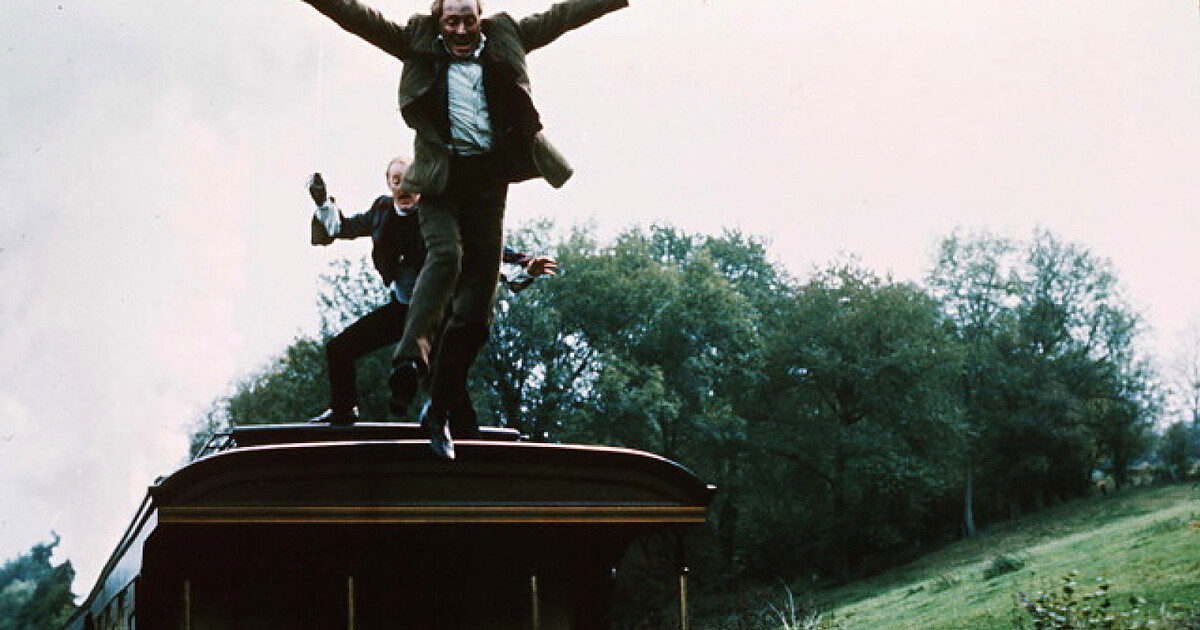
Fifty years ago this week, Sherlock Holmes took a very different kind of case. The Seven-Per-Cent Solution (1976), directed by Herbert Ross from Nicholas Meyer’s 1974 novel, stars Alan Arkin, Vanessa Redgrave, Robert Duvall and Nicol Williamson. It follows Dr. Watson and Mycroft Holmes as they trick a cocaine-addicted Holmes into travelling to Vienna for treatment by Sigmund Freud.
That premise made room for a period mystery with a very modern, frayed detective. Here is the breakdown of its making, music and reputation.
The score changed hands after a sudden death
Bernard Herrmann had been hired to write the score but died from a heart attack soon after. John Addison replaced him, having composed the music for Alfred Hitchcock’s Torn Curtain (1966) after a score by Herrmann had been rejected.
Sondheim slipped a song onto the soundtrack
Stephen Sondheim wrote a song for the movie, “The Madame’s Song”. It was later recorded as “I Never Do Anything Twice” on the Side By Side By Sondheim cast recording.
The novel began during a writers’ strike
In an 18-minute interview for the Blu-ray release by Shout Factory, Nicholas Meyer discussed the genesis of the idea: his father was a psychiatrist and Meyer was a fan of Holmes creator Arthur Conan Doyle. He took the opportunity to write the novel when the Writers Guild of America went on strike.
Meyer fought Ross over loyalty to the book
Meyer revealed that he had often fought with Herbert Ross because Ross was too faithful to Meyer’s novel. Meyer believed the script would not be cinematic enough if it was too faithful to the source.
Alan Arkin was Meyer’s choice for Freud
Meyer discussed the casting, including his push for Alan Arkin as Freud. The completed film stars Alan Arkin, Vanessa Redgrave, Robert Duvall and Nicol Williamson. In the story, Arkin’s Freud is the man Holmes must trust in Vienna.
Duvall was cast in revolt against old Watson
Meyer shared that he and Ross decided to cast Robert Duvall “in revolt” against Nigel Bruce’s portrayal of Watson as a “Colonel Blimp”-type character. They wanted to capture Watson’s intelligence that had not been portrayed on-screen in Holmes movie adaptations.
Real courts and libraries gave it period texture
The film was made at Pinewood Studios with location shooting in the UK and Austria, including the Austrian National Library. The tennis match/duel between Freud and von Leinsdorf was filmed on one of the historic real tennis courts at the Queen’s Club in West Kensington, London. Ken Adam was the production designer.
American critics gave it four-star treatment
The Seven-Per-Cent Solution was well received by American critics. On Rotten Tomatoes, 78% of 18 critics’ reviews are positive, with an average rating of 6.5/10. Gene Siskel of the Chicago Tribune gave the film four stars out of four and placed it ninth on his year-end list of the best films of 1976. Vincent Canby of The New York Times called it “nothing less than the most exhilarating entertainment of the film year to date.”
British reviewers were more critical. The Times called it “a turgid concoction which draws no life from the Holmes/Freud confrontation and seems particularly ill-plotted.” The Daily Telegraph said “The tale drags on for reel after reel before we cotton on to the fact that it is meant to be funny.” The Sunday Times said “the basic conflicts in Conan Doyle’s original dissipate into whimsy, cuteness and slow, period-laden self-indulgence.”
It created the template for modern Holmes
Mike Hale of The New York Times, after mentioning Robert Downey Jr.’s version of Sherlock Holmes, Benedict Cumberbatch in Sherlock and Jonny Lee Miller in Elementary, opined that Nicol Williamson’s Holmes was “the father of all those modern Holmeses.” He claimed the film “established the template for all the twitchy, paranoid, vulnerable, strung-out Holmeses to come.”
That is a lot of legacy for a mystery that turned 50 this week. Which of these facts is the one you will save for the next movie night?
Facts from Wikipedia: The Seven-Per-Cent Solution (film), available under CC BY-SA 4.0.
Film images from TMDB. This product uses the TMDB API but is not endorsed or certified by TMDB.