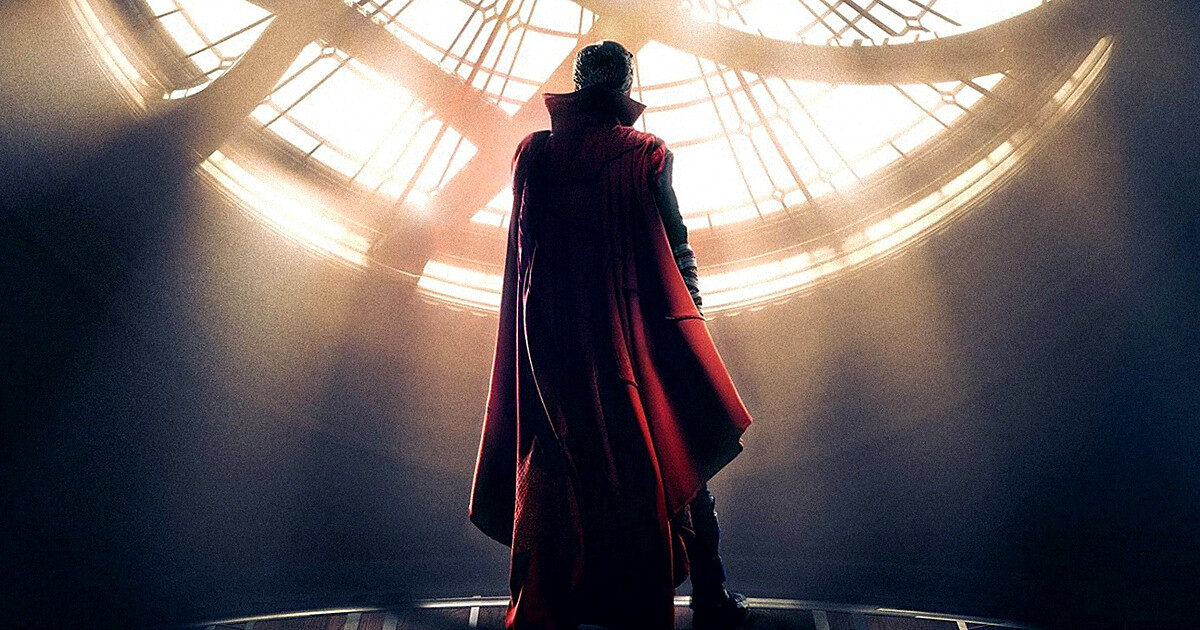
Doctor Strange (2016) turns 10 this week. Produced by Marvel Studios and distributed by Walt Disney Studios Motion Pictures, it is the 14th film in the Marvel Cinematic Universe. Directed by Scott Derrickson from a screenplay he wrote with Jon Spaihts and C. Robert Cargill, it stars Benedict Cumberbatch as Dr. Stephen Strange.
The Mirror Dimension did not arrive overnight. The property spent years in development, and the production had to plan its “psychedelic”, M. C. Escher-inspired imagery before cameras rolled.
A 1986 script that stalled
A film based on the Marvel Comics character Doctor Strange was initially listed as being in development at New World Pictures, with a script dated January 21, 1986, by Bob Gale; it never went further into production. By 1989, Alex Cox had co-written a script with Marvel Comics’ Stan Lee. That script had the character traveling to the Fourth Dimension before facing the villain Dormammu on Easter Island, Chile.
The rights relay
A film using this script was almost made by Regency, but Regency’s films were distributed by Warner Bros. at the time, which was in a dispute with Marvel over merchandising. Around this time, producer Charles Band optioned the property from Marvel and began developing a film at Full Moon Entertainment. The option expired before production could begin, and the project was reworked into the 1992 film Doctor Mordrid.
By December 1992, Wes Craven had signed to write and direct Doctor Strange for release in either 1994 or 1995, with Savoy Pictures distributing. By June 2001, Dimension Films acquired the film rights, with David S. Goyer back on board as writer and director; by August 2001, Miramax Films acquired the rights from Dimension.
Paramount’s $165 million plan
In April 2005, Paramount Pictures acquired Doctor Strange from Miramax Films, as part of Marvel Studios’ attempt to independently produce their own films. At the time, the film was projected to have a budget of no more than $165 million. In 2007, Guillermo del Toro and Neil Gaiman pitched a version of the film to Marvel, with Gaiman writing and del Toro directing.
Derrickson signs on
In June 2014, Scott Derrickson was chosen to direct the film. Derrickson said Doctor Strange was probably the only comic character in the mainstream world he was suited to, and he felt an affinity for the original Stan Lee and Steve Ditko Strange Tales. He had written a 12-page scene featuring Strange and an assailant fighting in the astral plane while a doctor attempts to save Strange’s physical body, based on a sequence from the comic Doctor Strange: The Oath.
Cameras roll in Nepal
Principal photography began in Nepal on November 4, 2015, under the working title Checkmate. Cinematographer Ben Davis described Doctor Strange as Marvel’s Fantasia, and noted that a lot of previsualization was required to figure out how to shoot the “psychedelic”, M. C. Escher-inspired imagery. Davis used the Arri Alexa 65 camera, along with the Arri Alexa XT Plus; Vision Research Phantom Flex 4Ks, which shoot up to 1000 fps, were used for high-speed sequences like Strange’s car crash.
Why Nepal, and why it mattered
Derrickson chose Nepal as a location to feature an “Eastern city” that would not be familiar to most audiences. After many scouted areas were destroyed by the April 2015 Nepal earthquake, Derrickson and Cumberbatch felt that bringing attention and tourism to Nepal following the event “was all the more reason to shoot there”. Cargill said the location of Kamar-Taj was shifted from Tibet to Nepal to prevent censorship by the Chinese government.
Rebuilding Kathmandu at Longcross
Production moved to Longcross Studios in Surrey, England on November 11, and was scheduled to stay there until March 2016. The real Kathmandu street that led into the fictional Kamar-Taj courtyard was replicated at Longcross. Production designer Charles Wood called that transition “very hard because Kathmandu is a most beautiful city and it’s steeped in history”, pointing to the shape of the streets, the warping of the buildings, and the ancient bricks and tiles. The set was dressed with real food, and populated with dogs, pigeons, and Nepalese extras, many of whom were relatives of people who live on the real Kathmandu street.
The Mirror Dimension arrives
Within the plot, the Ancient One demonstrates her power to Strange and reveals the astral plane and other dimensions such as the Mirror Dimension. Later, after a fight in the Mirror Dimension of New York, Kaecilius mortally wounds the Ancient One and escapes to Hong Kong. That mix of spirituality and otherworldly imagery is still the film’s calling card.
Which part of Doctor Strange’s decade-long journey to the Mirror Dimension is your favourite piece of the story?
Facts from Wikipedia: Doctor Strange (2016 film), available under CC BY-SA 4.0.
Film images from TMDB. This product uses the TMDB API but is not endorsed or certified by TMDB.