
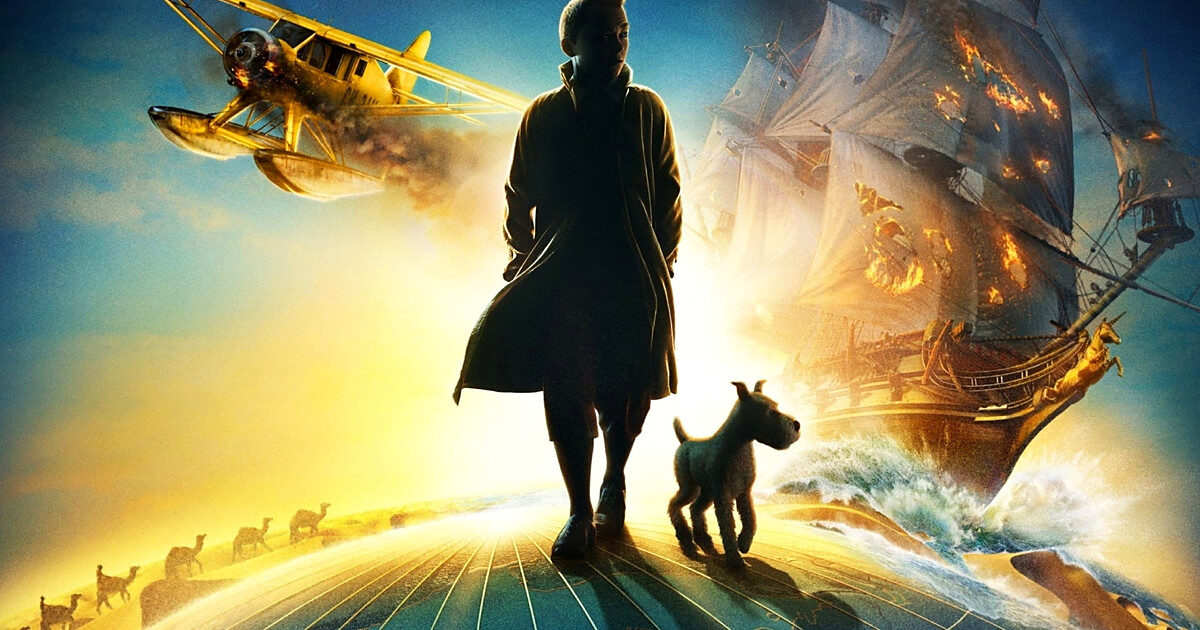
Steven Spielberg’s The Adventures of Tintin arrived in 2011 after a long, winding road through rights deals, near-casting and motion-capture experiments. Here are eight details from the making of the film that still surprise.
Spielberg wanted Jack Nicholson as Haddock
He became an avid Tintin fan in 1981 after a review compared Raiders of the Lost Ark to the comics. He commissioned E.T. the Extra-Terrestrial writer Melissa Mathison to script a film about Tintin battling ivory hunters, saw Tintin as an “Indiana Jones for kids” and wanted Jack Nicholson to play Haddock.
Hergé thought only Spielberg could do Tintin justice
Hergé disliked the previous live-action film versions and the Hergé’s Adventures of Tintin animated series. Michael Farr, author of Tintin: The Complete Companion, recalled Hergé “thought Spielberg was the only person who could ever do Tintin justice.” A meeting was scheduled in 1983 while Spielberg filmed Indiana Jones and the Temple of Doom in London, but Hergé died that week; his widow Fanny Remi decided to give them the rights.
The rights took a Hollywood detour
A three-year-long option to film the comics was finalized in 1984, with Universal Pictures as distributor. Unsatisfied with the script, Spielberg continued production on Indiana Jones and the Last Crusade; the rights returned to the Hergé Foundation. Claude Berri and Roman Polanski became interested, and Warner Bros. Pictures negotiated, but they could not guarantee the “creative integrity” that the Foundation found in Spielberg.
John Williams used an old Disney technique
John Williams composed and conducted the musical score for The Adventures of Tintin—his first score for an animated film and his first since 2008’s Indiana Jones and the Kingdom of the Crystal Skull. Most of the score was written while the animation was still in the early stages, with Williams seeking to employ “the old Disney technique of doing music first and have the animators trying to follow what the music is doing.” Several cues had to be revised during editing, and Williams used “1920s, 1930s European jazz” for the opening credits and “pirate music” for the battle at sea.
Spielberg kept both eyes open on Tintin
For every movie he made before Tintin, Spielberg kept one eye closed while framing a shot because he wanted to see the movie in 2-D, the way viewers would. On Tintin, he revealed, “I have both of my eyes open.”
Jackson directed Weta from a distance
Principal photography began in Los Angeles on 26 January 2009 and finished after 32 days of shooting in March 2009. Jackson was present for the first week and supervised the rest of the shoot via a bespoke videoconferencing program; Simon Pegg said Jackson’s voice would “be coming over the Tannoy like God.”
Snowy was the hardest character to animate
According to animators, Snowy was the hardest character to animate and develop, due to the type of coat he has as well as being white. A dog’s motion was captured digitally so the animators had inspiration for realistic movements, and Snowy’s vocal effects were taken from various breeds of dogs.
The Blu-ray ruled its first week
On 13 March 2012, Paramount Home Entertainment released The Adventures of Tintin on DVD and Blu-ray; combo packs included 11 behind-the-scenes featurettes. During its first week, the Blu-ray was the number-one-selling HD movie after selling 504,000 units and generating $11.09 million in sales.
Which making-of detail from The Adventures of Tintin is your favourite? Tell us in the comments.
Facts from Wikipedia: The Adventures of Tintin (film), available under CC BY-SA 4.0.
Film images from TMDB. This product uses the TMDB API but is not endorsed or certified by TMDB.