
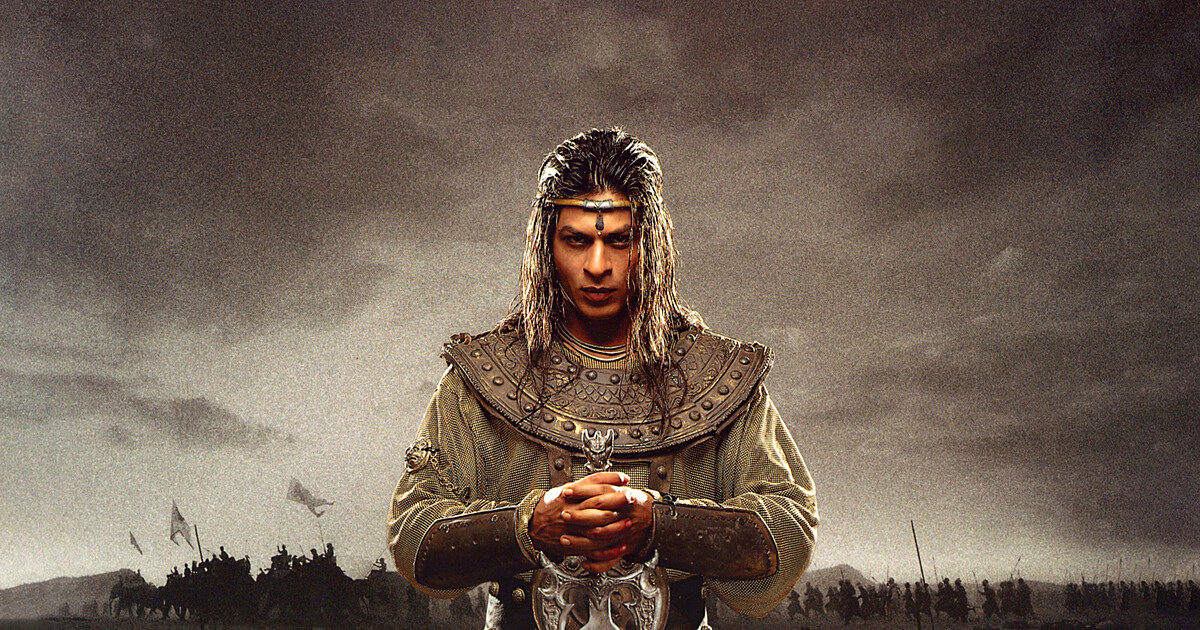
Asoka turns 25 this week and is back in the news with fresh stories from its Jaipur shoot. That is a good reason to revisit the film’s production file, which is full of strange costume fixes, enormous battle staging and a pitch made between shots on a moving train. Here are eight things you may not have known about the Santosh Sivan epic.
Santosh Sivan pitched it between shots on a train
Shah Rukh Khan was dancing in a train for a song in a movie, “Chaiyya Chaiyya” on the sets of Mani Ratnam’s Dil Se.., when Santosh Sivan came up to him between shots and told him about Asoka. Khan later said he could only understand half of what Sivan said, but he could see the determination in his eyes. “That’s 80% of the battle won. I was hooked,” he recalled.
Costume work began two years before filming
Santosh Sivan and principal costume designer Anu Vardhan started working on the project two years before the actual shooting began. While researching for the film, they discovered that body art was a prominent part of that time, which later shaped Kaurwaki’s look.
Shah Rukh Khan did not want to shoot shirtless
Anu Vardhan has said there was no concept of wearing vests during that era, but certain cinematic liberties were taken because Shahrukh did not want to shoot shirtless throughout the film. For his forest sequences, he wore square pieces of a blanket-like material, folded into two and cut in between, to pass around the neck. Another piece of cloth was tried around his waist, acting as a belt, and there was no stitching involved.
Kareena’s Kaurwaki wore researched tattoos
Because body art was a prominent part of that period, the costume team used different designs of tattoos for the character of Kaurwaki, played by Kareena Kapoor. Anu Vardhan explained this while discussing the film’s costume research.
4,000 fibreglass jackets came from Madras
The armours and shields worn by the artistes were an important part of the costume for the final war sequences. Metal jackets composed of special fibre glass were made for around 4000 members of the cast. More than 50 workers made them in Madras, and Vardhan said they were extremely light and comfortable.
Sabu Cyril created the whole film with six pillars
Production designer Sabu Cyril gave different parts of the film different looks. When the viewer is taken to Magadha in Bihar, the temples and houses were made using black granite, while Kalinga got brown sandstone and earth tones. Cyril said he worked with only six pillars in the film, which is hard to imagine once you see it.
Jaipur hosted the battles, but half of it was shot indoors
The production moved across locations including Pachmarhi for the bulk of the romance, Maheshwar for the palace intrigues of Pataliputra, Jaipur for battle scenes, Igatpuri and Bhubaneswar for the Kalinga portions. More than half the film was shot indoors on the studio floors of Film City and Filmistan.
The final battle employed over six thousand extras
The elaborate final battle scene, fought against the Kalingas, employed over six thousand extras and hundreds of elephants. Some of the actors portraying warriors in the film were masters of Kalari.
Twenty-five years later, these details still show how Asoka was built like a historical world and not just a star vehicle. Which of these Asoka making-of stories had you not heard before? Tell us your favourite fact.
Facts from Wikipedia: Asoka (2001 film), available under CC BY-SA 4.0.
Film images from TMDB. This product uses the TMDB API but is not endorsed or certified by TMDB.